Author
“Fast-track”/accelerated procedures
The list of safe countries of origin, based on which the accelerated procedure may be applied, was expanded in 2019 to cover three new countries, namely Namibia, Uruguay and South Korea. On the contrary, Sri Lanka and Ukraine were deleted from the list (2019 and 2022, respectively).
The so-called “fast-track procedure” (see Fast-Track Processing), was initiated in 785 (2024: 1,346; 2023: 8,285; 2022: 32,875) cases in 2025, leading to 586 (2024: 1,389;2023: 8,241;2022: 23,297) decisions, of which none were decided in an accelerated procedure. On average, a decision in fast-track procedures, which mostly applies to persons from countries listed as safe countries of origin and manifestly ill-founded applications was taken in 36 days.[1]
Afghanistan
The situation of Afghan asylum applicants changed considerably in 2021: Austria hosts one of the largest Afghan diaspora communities in Europe. At the start of the year, recognition rates concerning subsidiary protection were decreasing compared to previous years. In June 2021, the death of a 13-year-old girl that had been raped several times (the Causa Leonie case) initiated a public debate as the alleged perpetrators were Afghan nationals who were asylum applicants or who had previously applied for asylum. This led the public to urge authorities to carry out an increased and faster number of removals of rejected asylum applicants with a criminal record, thereby contributing to the anti-Afghan-narrative.
After the fall of Kabul and the takeover by the Taliban in summer 2021, the situation changed. Even though Austria was one of the last countries to stop deportations to Afghanistan, the Ministry of Interior continued to state in public that Austria would resume deportations to Afghanistan as soon as possible. Starting from August 2021, the number of discontinued cases of Afghan nationals thus started to rise as they moved on to other countries. This is also closely linked to the Anti-Afghan-propaganda of the Ministry of Interior in the context of the Causa Leonie case.
Return decisions were issued by a small group of BVwG judges between September and December 2021, but they were halted by another landmark ruling by the Constitutional Court stating that this would breach Art 3 ECHR.[2] Since then, all decisions involving Afghan nationals have been granting protection. In 2022 and 2023, return decisions were issued in single cases but no deportations to Afghanistan took place or were planned. Following the deportations of Afghan nationals by Germany, the Austrian ministry of Interior announced that it would work with Germany on joint deportations to Afghanistan.[3] NGOs highlight this announcement is to be seen as part of the Austrian policy of trying to shape public debate.
In early 2025, senior Austrian officials visited Afghanistan to discuss cooperation on removals, a trip involving two BFA officials and three police officers that cost just under € 21,000.[4] In autumn 2025, representatives of the Taliban administration travelled to Austria to identify Afghan nationals and, where appropriate, issue travel documents to facilitate their deportation, a move that prompted public criticism and legal questions about how Taliban officials were permitted to enter Austria and the EU given that Austria does not recognise the Taliban as a legitimate government.[5] The Austrian Supreme Court has also continued to categorise the Taliban as a terrorist organization.[6] Nevertheless, the delegation was invited at the Austrian state’s expense, with a focus on identifying individuals with criminal convictions; the visit cost €16,252.28.[7] October 2025 saw Austria carry out its first deportation to Afghanistan since the Taliban takeover, followed by another in November 2025, and further cooperation included another Taliban visit in spring 2026.[8] In total, three people were removed to Afghanistan in October, November, and December 2025, at a combined cost of €26,585.62 – roughly €9,000 per person.[9]
This deportation practice and the evident operational cooperation with the Taliban, seen by many as at least a de facto, technical-level recognition, have been strongly criticized by NGOs, civil society organisations, and the Afghan exile community; although the ECtHR received Rule 39 requests in connection with these removals, it declined to indicate interim measures to halt them.[10] Removals to Afghanistan continued in 2026 on an individual basis.[11]
In September 2022, the Supreme Administrative Court referred a case concerning an Afghan woman to the CJEU for guidance on two questions relating to Art 9 of the Qualification Directive: Firstly, whether a combination of measures adopted, encouraged or tolerated by a state which limit a women’s freedom could amount to persecution within the meaning of Article 9(1)(b) of the Qualification Directive (recast) and secondly, whether a woman who is affected by such measures taken by the state should be granted refugee status solely on the basis of her sex or if it would be necessary to examine the individual circumstances of the applicant to determine how the measures impact a woman’s individual situation.[12] The opinion of the Advocate General concluded that a combination of measures could amount to persecution per the Qualification Directive when those have the cumulative effect of depriving those women and girls of their most basic rights in society and thus undermine full respect for human dignity, and that the authorities could consider there was a well-founded fear of being subjected to such acts of persecution on account of gender, without having to look for other factors particular to the person’s personal circumstances.[13]
On 4 October 2024, the European Court of Justice (CJEU) ruled in cases C-608/22 and C-609/22 that Afghan women are persecuted by the Taliban on account of their gender and are therefore at a general risk of persecution; that is to say, that nationality and gender are sufficient for refugee status within the meaning of Directive 2011/95/EU.[14] Provided the decision is consistently applied in national practice, the administrative process should be faster, as individual case examination is no longer necessary in the context of asylum applications by Afghan women.
This decision was criticised heavily by Austrian media and the far right political party FPÖ. The conclusion drawn by renowned legal experts such as Walter Obwexer (Head of the Law Faculty Innsbruck) and former head of the Austrian Oberster Gerichtshof, Irmgard Griss, was that the situation would mean a “pull-effect” and “human traffickers would only need to bring Afghan women to Europe” and the men would then arrive via family reunification.[15]
These assumptions however find no bearing of proof in practice: the number of asylum applications by Afghan women in Austria only increased significantly after the judgement because of more subsequent applications by Afghan women who have already lived in Austria before, with subsidiary protection status. Just like in Finland, Sweden or Denmark, that already had already implemented the caselaw in practice in 2022/2023, there was no rise of first time applications by Afghan women.
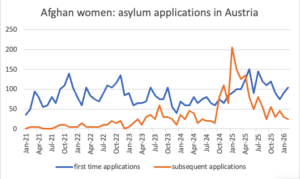
Data: Eurostat; diagram by asylkoordination österreich
Syria
After the fall of the Assad regime in December, all asylum procedures of Syrian nationals were suspended. The ministry of Interior announced that it would start planning deportation programs, which sparked fear among BIPs. Until the end of 2024, more than 500 withdrawal procedures were initiated because of alleged improvement of the situation in Syria. By end of March, there were more than 6,000 withdrawal procedures pending at first instance, most of them concerning Syrian nationals.
Beginning in early 2025, Austria’s Interior Ministry moved to restart removals to Syria, culminating in a joint visit by the Austrian interior minister and his German counterpart to engage the “new regime” on future deportations – a high‑profile trip that underlined Vienna’s intent and cost € 31,031.09.[16] In early June 2025, Austria scheduled its first deportation. The ECtHR initially indicated interim measures but lifted them a week later, clearing the way for removal.[17]
In early July, Austria carried out the deportation, reported as the first forced return from Europe to Syria in more than a decade, and the individual has been missing ever since. His case prompted a complaint to the UN Committee on Enforced Disappearances (CED) with a request for interim measures, after which Austria was instructed to investigate his fate and whereabouts, including via diplomatic engagement with Syrian authorities, and to seek diplomatic assurances for his safety and humane treatment. Austria at first complied only inadequately: according to counselling organisations, it was later acknowledged in the CED proceedings – and confirmed by Syria – that the deportee had been detained by the regime, though his location and health remain unknown, so he is still considered disappeared.[18]
The policy drew strong criticism, with observers stressing that Syria is not sufficiently safe to ensure returns without a real risk of serious harm; the ECtHR also faced criticism amid debate about political pressure from European governments alleging overly expansive case law on deportations for certain groups.[19] After further ECtHR intervention that again did not lead to an extension of interim measures, Austria carried out another deportation on 2 October 2025, and by year’s end three people had been removed to Syria at a total cost of € 22,615.70.[20]
Somalia
In early 2025, Austria signalled a major policy shift by announcing the resumption of deportations to Somalia after nearly two decades, framing removals as limited, case‑by‑case returns despite Somalia’s persistently fragile security situation. At the same time, internal communications and reporting pointed to significant concerns about risks on the ground and the apparent informality of contacts with Somali actors, raising doubts as to whether any structured or politically endorsed cooperation framework actually exists.[21]
Over the course of the year, the government moved from planning to implementation: according to official information, deportations to Somalia did take place, confirming that returns were already being executed in practice.[22] Authorities also prepared a charter removal via Nairobi – limited to four individuals from Austria rather than a large‑scale operation – but the attempt ultimately failed after onward transfer from Kenya proved impossible; three of the four people returned to Austria, underscoring unresolved issues such as missing travel documents and, more fundamentally, the absence of clear, reliable cooperation with Somali authorities.[23]
Taken together, developments in 2025 reveal a policy that is being actively pursued yet remains opaque: it is unclear with which Somali officials Austrian authorities are coordinating, whether such arrangements are endorsed at higher political levels, and how these efforts square with public statements by Somali representatives denying comparable deportation agreements with European states.[24] Information from counselling organisations indicates that the programme has continued into 2026, with further removals carried out or prepared, even as legal, diplomatic, and human rights concerns persist. The total cost of deportations to Somalia in 2025 amounted to €35,453.69.[25]
[1] Ministry of Interior, Answer to parliamentary request 4298/AB, 27 March 2026 available in German here.
[2] VfGH, E4227/2021, 16 December 2021, summary in English available here.
[3] Euronews, ‘Austria joins Germany in deporting Afghans with criminal records back home’, 1 September 2024, available at: https://shorturl.at/fAq5k.
[4] Ministry of Interior, Answer to parliamentary request 4290/AB XXVIII. GP, 27 March 2026, available in German here.
[5] Der Standard, “Talibanvertreter reisten nach Wien, um bei Afghanistan-Abschiebungen zu helfen” 11.09.2025, available in German here.
[6] OGH, decisions 12Os151/21d, 24.02.2022, avialable in German here.; 12Os74/18a, 23.08.2018, avialable in German here.
[7] Ministry of Interior, Answer to parliamentary request 4290/AB XXVIII. GP, 27 March 2026, available in German here.
[8] Der Standard, “Erste Abschiebung aus Österreich nach Afghanistan seit Taliban-Machtübernahme” 21.10.2025, available in German here; Der Standard, Weiterer Afghane aus Österreich in seine Heimat abgeschoben, 9 November 2025, available in German here.
[9] Ministry of Interior, Answer to parliamentary request 4290/AB XXVIII. GP, 27 March 2026, available in German here.
[10] asylkoordination, “Asylpolitischer Rückblick 2025”, 11 December 2025, available in German here.
[11] Minsitry of Interior, “Abschiebeoffensive fortgesetzt: Abschiebungen verurteilter Straftäter nach Afghanistan gehen weiter” 25 January 2026, available in German here.
[12] VwGH, Ra 2021/20/0425 and Ra 2022/20/0028, 14 September 2022 (C-608/22, C-609/22), available in German here, to follow the evolution of this case, see procedure before the CJEU, registered as case C-608/22 here.
[13] CJEU, AH (C-608/22) and FN (C-609/22) intervener: Bundesamt für Fremdwesen und Asyl, Opinion of Advocate General Richard de la Tour, 9 November 2023, available here.
[14] Vgl Koymali, How an ECJ Ruling Affects the Lives of Afghan Women, voelkerrechtsblog, 19 March 2025, https://shorturl.at/bG94Z.
[15] Der Standard, „EuGH Urteil zu Afghaninnen: Österreich bleibt bei Einzelfallprüfungen“, 7 October 2024, available in German at: https://shorturl.at/cPstW.
[16] Der Standard, „Innenminister Karner mit deutscher Amtskollegin Faeser in Syrien“, 27 April 2025, availabe in German here; Ministry of Interior, Answer to parliamentary request 4290/AB XXVIII. GP, 27 March 2026, available in German here.
[17] Deserteurs- und Flüchtlingsberatung, “Österreich versucht erstmalig Abschiebung nach Syrien”, 23 June 2025, available in German here.
[18] Der Standard, “Syrer aus Wien nach Damaskus abgeschoben, weitere Flüge in Planung“, 3 July 2025, available in German here; Der Standard, “Abschiebung nach Syrien: Karner nennt Uno-Appell “weltfremd“, 8 August 2025, available in German here.
[19] AI, Abgeschobener Syrer verschwunden: “UN-Aufforderung ist Armutszeugnis für Österreich”, 8 August 2025, avaialbe in German here; Deserteurs- und Flüchtlingsberatung, “Österreich versucht erstmalig Abschiebung nach Syrien”, 23 June 2025, available in German here; asylkoordination, “Asylpolitischer Rückblick 2025, 11 December 2025, available in German here.
[20] Der Standard, “Wieder Syrer in sein Herkunftsland abgeschoben“, 2 October 2025, availabe in German here; Ministry of Interior, Answer to parliamentary request 4290/AB XXVIII. GP, 27 March 2026, available in German here.
[21] Der Standard, “‘Hi Bro’ ans Innenministerium Österreichs: riskante Abschiebung nach Somalia”, 5 September 2025, available in German here.
[22] Der Standard, “Asyl: Erste Abschiebungen nach Somalia seit rund 20 Jahren”, 3 September 2025, available in German here; BMI, “Abschiebung nach Somalia durchgeführt”, 3 September 2025, available in German here.
[23] Der Standard, “Erste Abschiebung Österreichs nach Somalia via Charterflug steht bevor”, 5 December 2025, available in German here; Der Standard, “Von Wien nach Nairobi und zurück: Charter-Abschiebung von Somaliern gescheitert”, 11 December 2025, available in German here.
[24] Der Standard, “‘Hi Bro’ ans Innenministerium Österreichs: riskante Abschiebung nach Somalia”, 5 September 2025, available in German here; AA, “Somalia ‘firmly’ rejects allegations of ‘secret’ deportation deal with Sweden”, 8 October 2025, available here.
[25] Ministry of Interior, Answer to parliamentary request 4290/AB XXVIII. GP, 27 March 2026, available in German here.