
Author

Asylum applicants are allocated to a specific reception facility through a dispersal scheme operated by IGI-DAI. The Regional Centres for Accommodation and Procedures for Asylum applicants are located in the following areas:
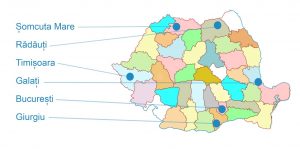 Source: AIDRom, Support for asylum applicants in Romania available here.
According to the Asylum Act, asylum applicants are not allowed to leave their place of residence without authorisation from IGI-DAI.[1] The request to leave the residence has to include the address, the full name of the person with whom the applicant will be staying and the period of time and reasons for their request to leave.[2] Authorisation is issued following an individual, objective and impartial assessment. In case IGI-DAI refuses to grant authorisation, its decision shall be motivated.[3]
The provision of material conditions is subject to the applicant’s actual residence in the assigned centre. This is monitored by IGI-DAI through its database. If an applicant leaves the Regional Centre without permission and does not return in 72 hours, IGI-DAI may apply Reduction or Withdrawal of Reception Conditions.
According to CNRR,[4] persons in the centres have freedom of movement, but they need the approval of the management staff in case of long absence (more than 1 day). All the asylum applicants have to notify IGI regarding any residency change.
Transfers between centres
In 2024, according to JRS Romania, transfers between regional centres were carried out, including from Timișoara to Bucharest, Rădăuți, Giurgiu, and Șomcuta Mare. Additionally, vulnerable cases were relocated from Bucharest to Galați due to renovation works at the Bucharest centre. However, no precise figures are available regarding the total number of transfers conducted during the year.[5]
In 2024 social assistance was affected by the gaps of AMIF funds. In 2025, funding under AMIF was resumed, enabling NGOs to continue providing assistance.[6]
Restrictive measures
In 2023, according to IGI-DAI data, there were situations when restrictive measures were imposed on asylum applicants:[7]
- There were no such measures ordered with regard to the Galaţi centre;
- 9 measures mandating that the person present themselves at the centre, in the context of the Dublin procedure, and 25 measures establishing residence in the centre, were ordered at the Timișoara centre;
- 32 measures mandating that the person present themselves at the IGI-DAI Giurgiu, in the context of the Dublin procedures, and 431 orders establishing residence in the centre, were ordered at the Giurgiu centre;
- 19 orders establishing residence in the centre, were ordered at the Bucharest centre;
- Residence was established at the Şomcuta Mare centre in 367 cases.
- Residence was established at the Rădăuţi centre in 367 cases.
According to IGI-DAI, in 2024, 128 decisions assigning a specific residence, reception centres, for the asylum applicants, were taken, in line with article 19(4) of the Asylum Act, a reduced number compared to previous years.[8] No updated information was provided by IGI-DAI for 2025 regarding the number of such decisions or their application in practice.
[1] Article 19(g) Asylum Act.
[2] Article 7 Asylum Decree.
[3] Article 19(g) Asylum Act.
[4] CNRR, Input by civil society organisations to the Asylum Report 2024, 2023, available here.
[5] Information provided by JRS Romania, July 2025.
[6] ibid., March 2026.
[7] ibid. 18 January 2024.
[8] ibid. 23 January 2025.